

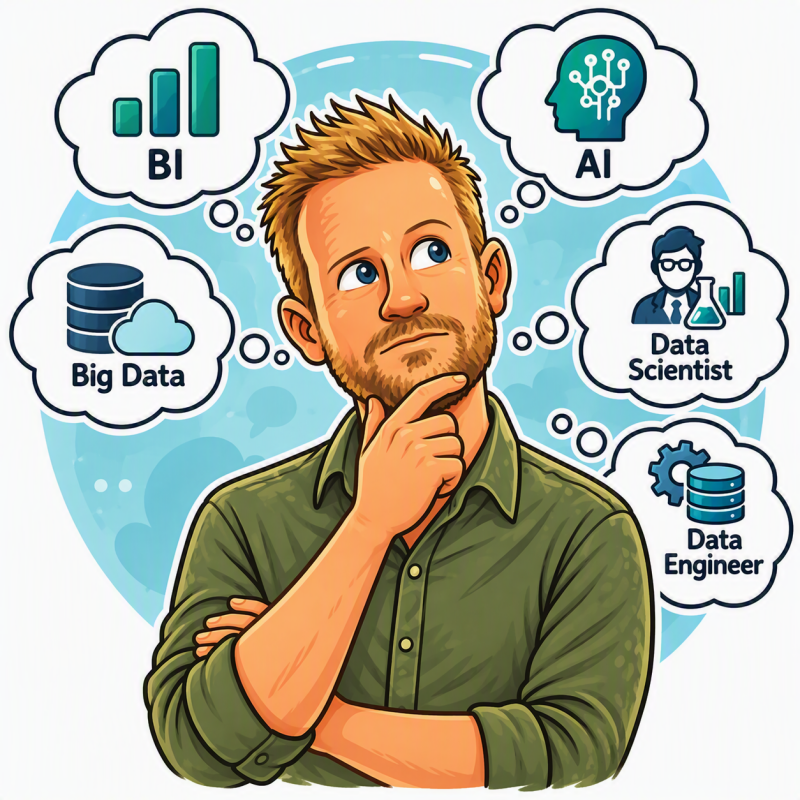
Over the past years, I've worked in many different data roles. When I started my consulting career, I was hired as a BI Consultant. The funny thing? I had no idea what BI, Business Intelligence actually was. My first customers were pure BI consulting engagements. Back then, a BI Consultant was typically defined as someone who:
Helps organizations make better business decisions by collecting, integrating, analyzing, and presenting business data.
Sounds familiar? Because this is still what many of us do today.
The Rise of Big Data
A few years later, a new buzzword appeared: Big Data. Suddenly, everyone wanted to be a Big Data Consultant instead of a BI consultant. Cloud platforms emerged, storage became practically unlimited, and scalability was no longer a problem you had to solve yourself. Technologies changed rapidly, and organizations started processing larger and larger datasets.
But was there really a functional difference between a BI Consultant and a Big Data Consultant? Not really right.
Sure, we worked with more data. We used different tools. We worried more about scalability and performance. But the end goal remained exactly the same:
Turning data into value that helps people make better decisions.
The technology changed. The mission didn't. Make better (business) decisions.
One thing that always appealed to me about being a BI Consultant was the end-to-end nature of the role. You could work on everything, from extracting data from source systems to building reports and dashboards for business users.
Enter the Data Scientist
With a master's degree in Econometrics, another role naturally crossed my path: a Data Scientist.
At first glance, this role felt different. A Data Scientist is often described as someone who:
Transforms data into predictive insights and data-driven solutions by combining statistical analysis, machine learning, and domain expertise.
A BI Consultant mainly answers: What happened?
A Data Scientist focuses more on: What will happen next?
So a BI Consultant focuses in the first place on prescriptive insights. Where a Data Science is focused on predictive insights.
However, once again, the underlying purpose remains surprisingly similar. Both roles transform data into insights that help organizations make better decisions. Different techniques. Same end goal. Make better (business) decisions.
The Rise of Data Engineering
As the years passed, I took on different responsibilities. I worked as a Data Analyst. Later as a Finance Product Owner. Stakeholder management became an increasingly important part of my work. But still focussing on the data part from a business perspective.
Later at another customer, my focus shifted from SQL towards Python development to build data products.
Suddenly, my job title became a Data Engineer. A Data Engineer can be described as someone who:
Enables the reliable flow of data from source to consumption, ensuring that data is available, trustworthy, and usable for business and analytical purposes.
If you read that carefully, it still sounds very close to the original BI Consultant definition.
The key difference is focus. Traditionally, the BI Consultant worked across the entire chain. The Data Engineer focuses more on the backend of the platform.
Based on that, I noticed the BI Consultant role gradually splitting into two directions over time.
- Data Engineering
- Analytics Engineering / Reporting
The introduction of Power BI accelerated this trend even more. Before Power BI became dominant, BI often included everything: data extraction, data warehousing, modeling, reporting, and analytics. After Power BI, the term BI became increasingly associated with dashboards and reporting, while data integration and modeling shifted into the Data Engineering domain. Because I continued doing both sides, the platform work and the reporting work, I eventually started calling myself a Data & Analytics Consultant.
And Then AI Happened
Fast forward to today. You almost can't attend a conference, open LinkedIn, or have a customer conversation without hearing about AI. Apparently, you're no longer cool if you don't talk about AI.
Now a new role emerged: the AI Engineer.
Which is typically defined as:
Someone who develops and implements intelligent systems that can learn, reason, and assist in solving business problems or automating tasks.
Do you already notice something interesting?
The definition doesn't mention:
- LLMs
- Copilot
- OpenAI
- or Agents
And that's very important. Just as ETL tools, data warehouses, and BI platforms evolved over time, AI technologies will continue to evolve as well.
The real objective remains:
Solving business problems with data.
Personally, I see AI Engineering as a natural evolution of Data Science. In the past, we built predictive models ourselves. Today, we increasingly use pre-trained foundation models and large language models to generate value directly.
The tools have changed dramatically. The purpose hasn't. And once again: the end goal is the same. Be able to make better (business) decisions. Data remains the fuel.
Different Roles, Different Questions
Looking back, I think every major data role answers a different question.
| Role | Question |
|---|---|
| Data Engineer | Can we trust and access the data? |
| BI Consultant | What happened and why? |
| Data Scientist | What is likely to happen next? |
| AI Engineer | How can we automatically act on it? |
Different questions. Different specializations. But they all share one common goal:
Turning data into business value.
So What Am I in 2026?
Over the years, I've had many roles:
- BI Consultant
- Business Analyst
- Solution Architect
- Data Analyst
- Product Owner
- Data Engineer
- Data & Analytics Consultant
Today, I usually introduce myself as a Data & Analytics Consultant or a Microsoft Fabric Consultant. Sounds a bit silly, right? Because when I look at my daily work, I'm still operating across the entire chain. And I'm not the only one. There are many names for the role:
- BI Consultant
- Data Consultant
- Analytics Consultant
- Fabric Consultant
- Data & AI Consultant
The title may have changed, but the essence of the job hasn't. These professionals all work across the end-to-end data landscape, helping organizations turn data into actionable insights and better decisions.
Looking Ahead
A BI Consultant in 2010 and a Fabric Consultant in 2026 have more in common than you might think. The technology changed. The job title changed. The why didn't. The mission remains helping organizations turn data into better decisions and real business value.
Whatever the title is in 2035, that's still the role I want to play: as Your Analytical Bridge, to help you make better (business) decisions.
What defines your role?