

In the previous blog, we explored my data journey to answer one key question: What is BI?Now, let’s continue that journey and see how this connects to broader data patterns and data flows.
But first answer the question: What is a data flow?
A data flow is a logical representation of movement of data from one place to another.
To make this easier to understand, let’s look at a simple flow. Let’s see the journey from a Seed (A) to Food (B). Let’s put this into a clear picture.
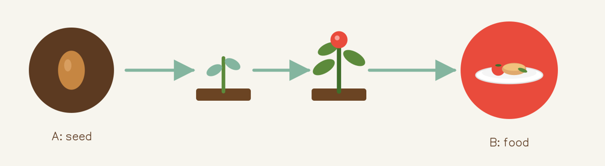
The image shows a step-by-step progression:
- A seed (A)
- Growing into a small plant
- Then a flowering plant
- Finally becoming food (B)
Each step is connected with arrows, showing movement or transformation over time.
Although this is not data, it represents the same concept of a flow. Something moves through different stages to reach an end result.
Data flow
Now let’s bring this back to data flow, using point A and point B.
Point A represents the source data. Point B represents the business value, the place where insights live and decisions are made. In other words, this is your end-to-end journey. And as we already know, that business value is what enables companies to act, decide, and move forward with confidence.
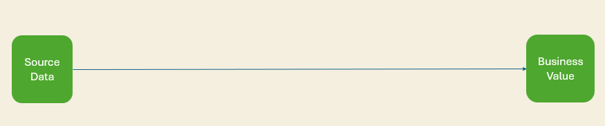
But… just like in the plant example, something important is happening in between.
So let’s zoom in.
Between A and B, data doesn’t just magically transform itself into value It follows a structured journey.
Remember the previous blog? In here we identified 5 key sentences out of the BI definition.
- Data gathering
- Data storage
- Knowledge management
- Analyses
- Presentation
If we place the five core elements between source data and business value, something interesting happens. They don’t happen randomly, they follow a clear order and a clear sequence.
Suddenly… this starts to look very familiar. This is a BI Data architecture
The classic STG → DWH → DM → OLAP setup maps directly to the stages we defined in the BI process.
Pretty cool, right?
If you’ve worked with data architectures in BI, you’ve probably seen this before, maybe under different names, maybe in a slightly different shape, but the concept is the same.
Let’s call this for now the General Data Architecture we have defined.
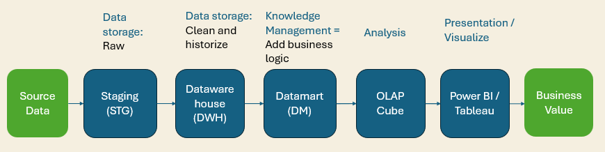
This concept is cloud agnostisch and helps to add get business valuable insights from your data. The funny thing is, I have seen more of these data architectures in my life. This one refers to a traditional BI solution, that can live on a SQL server for example.

At its core, it usually consists of three main layers, the foundation of any BI solution.
And once you see it… you start to recognize a pattern.
In the next blog, we’ll dive deeper into these patterns and explore how they show up in different data architectures.