

In my previous blogs, I compared several data patterns and discovered something interesting: no matter which architecture we look at, the same recurring pattern keeps showing up.
That brings us to the final piece of the puzzle: the Medallion Architecture.
Let's start with the definition.
Definition Medallion Architecture
The Medallion Architecture is a layered data‑design pattern that organizes data into three progressively refined tiers:
Bronze, Silver, and Gold.
So that data quality, structure, and business value increase at each step.
Its purpose is to ensure scalable ingestion, reliable transformation, and high‑quality, analytics‑ready data across modern Lakehouse platforms.
- 🔶 Bronze: Raw
The landing zone for raw, unprocessed data exactly as received from the source. No validation, no cleaning; preserves lineage and history. - ⚪ Silver: Cleaned & Validated
Data is deduplicated, cleansed, conformed, and structured. This layer provides reliable, analytics‑ready datasets used by analysts, data scientists, and downstream processing. - 🟡 Gold: Business‑Ready
Curated, enriched, and often aggregated datasets optimized for BI, reporting, KPIs, and decision‑making.
A nice and clean definition. But if we take a closer look, some key phrases immediately stand out:
- Raw, unprocessed data
- Cleansed, conformed, and structured
- Aggregated Datasets
- Reporting, KPI’s
- Decision-making
Look familiar?
They should.
Back in Part 1 of this series [link], we looked at the classic BI definition from the 1990s. When you compare that definition with the Medallion Architecture, the similarities are hard to miss.
The principles are nearly identical.
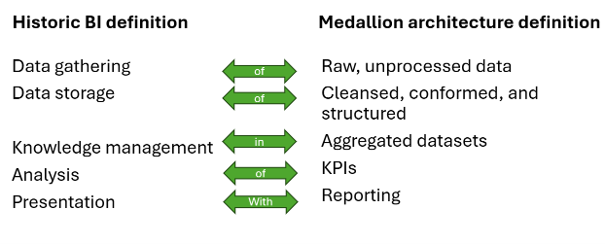
In fact, you could argue that the Medallion Architecture is simply the modern expression of concepts that have existed in Business Intelligence for more than 35 years.
And that raises an interesting question:
Is the Medallion Architecture unique, or does it appear in every data architecture?
Let's find out.
The Pattern Behind the Pattern
In Part 1, we introduced the General Data Architecture.

When we compare that architecture with the Medallion Architecture, something remarkable appears:
- The ingestion layer maps to Bronze
- The historical and validated layer maps to Silver
- The business consumption layer maps to Gold

In other words:
The Medallion Architecture already existed inside traditional BI architectures.
And when we look at the overview from Part 3 [Link], where multiple data patterns are combined, we see exactly the same thing.
Different names.
Different technologies.
Different diagrams.
But fundamentally the same pattern.
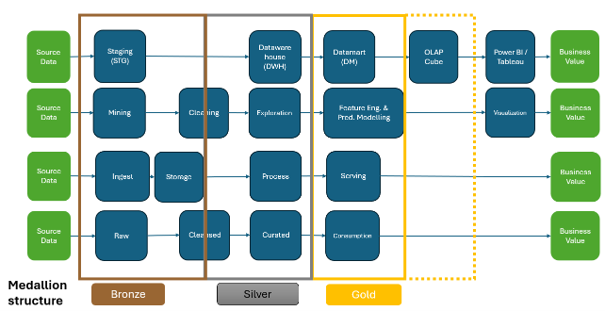
Those blocks clearly describe and contain the medallion architecture in it.
So, for all those years, I have been doing the same! Wel we are all doing the same! And all data patterns end up to contain the Medallion Architecture in some format.
For years we've been building data architectures using these principles. Long before anyone called them Bronze, Silver, and Gold. For over 35 years!

In reality, the Medallion Architecture is not about having three folders called Bronze, Silver, and Gold.
It's about applying three fundamental rules:
- A raw landing layer
- A cleansed and historical layer
- A business-ready layer containing logic, definitions, and insights
Therefore, no matter what data pattern we use, or which technology we are using, we are still running the 3 fundamental ground rule, which always lead back to the MEDALLION ARCHITECTURE, or should we say general Data Architecture?!
That's why I believe every modern data pattern eventually leads back to the same foundation.
What's Next?
Now that we've seen how the Medallion Architecture appears across decades of BI and data platform design, one important question remains:
Why are we doing this?
More importantly:
What business value do these layers actually provide?
We'll dive into that in Part 5 of this blog series.
Stay tuned!