

The Medallion Architecture Unveiled: Why the Business Should Care (And Why AI Still Needs It)
After weeks of my blog series The Medallion Architecture Unveiled, it is time for the final chapter!
In the previous blogs, I explored different data patterns, started with the BI journey, and ultimately showed that the Medallion Architecture is not a new invention at all. In many ways, it is the same general data architecture we have been using for years, ever since we started talking about Business Intelligence. Now it is time to look at the value it brings to the business, both today and in an AI-driven future.
Earlier in this series, we identified three core layers that form the foundation of almost every modern data platform. The names may differ, but the concept remains the same:
- A raw landing layer
- A cleansed and historical layer
- A business-ready layer containing logic, definitions, and insights
We have seen that this three-layered approach has existed for years. The reason is actually quite simple, they are:
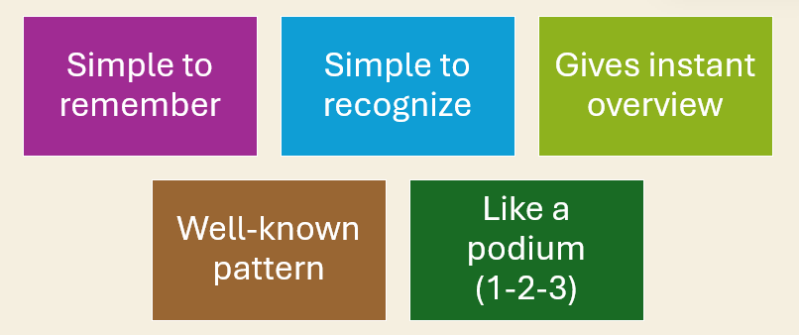
In short, this architecture brings clarity, consistency, and a shared understanding to your data platform.
But Why Should the Business Care?
Now that we know the architecture is simple and widely understood, the next question naturally arises
Why should the business care?
Why do we, as consultants, continue to advocate for this architecture in modern data platforms? The answer comes down to five key benefits:
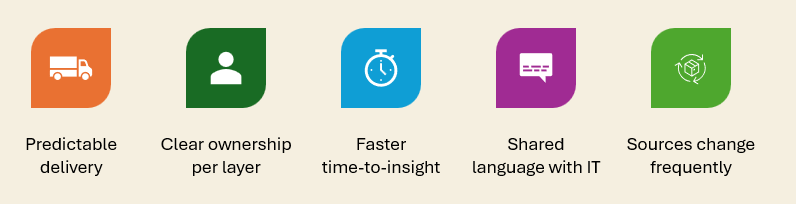
The architecture brings structure and predictability to data delivery, making projects easier to plan and execute. Clear responsibilities per layer simplify ownership, while the separation of concerns allows analytics teams to focus on insights rather than data fixes. Because both business and IT understand the concept, it creates a shared language that improves collaboration. And when source systems change, the impact remains contained, protecting reports and dashboards from disruption.
My Rule of Thumb

Based on my experience, this is still the approach I use when starting a new data platform at a client. I start with the plan and stick to my plan. And the plan usually contains three layers. Of course, there is always room for discussion about what exactly belongs in each layer.
You Might:
- Apply some transformations in Bronze.
- Move certain transformations to Silver.
- Add a landing layer before Bronze.
- Split Silver into multiple layers.
- Introduce verified datasets on top of Gold and call them Platinum.
All of that is possible.
And honestly, all of it can be valid depending on your requirements. Especially the business requirements.
But regardless of the naming, technology, or implementation details, those three core concepts remain recognizable:
Raw.
Historical.
Business-ready.
That structure keeps showing up for a reason.
What About AI?

I can already hear some of you thinking:
"Nice story, Benito, but what about AI? Isn't AI going to solve all of this for me?"
A fair question. AI is moving incredibly fast.
Some would still call it a hype, while others already see it as a proven productivity booster. Compared to a few years ago, I can confidently say that AI has become one of my best daily friends. Whether I am using Claude or Copilot, AI helps me find answers faster, troubleshoot issues, write code, and accelerate deployments.
And yes, AI can add value in every layer of the architecture.
- In the raw layer, AI can help classify data, detect sensitive information, interpret schemas, and monitor changes over time.
- In the cleansed and historical layer, AI can support transformations, suggest mappings, enrich data, and help create trustworthy datasets.
- In the business layer, AI becomes truly business-facing through natural language interactions like: "Why did sales drop last month?"
It can generate insights, explanations, summaries, dashboards, and even complete reports. This all sounds impressive. But there is one important thing AI cannot do:
It cannot magically fix bad data. AI still relies on structured, validated, and well-governed information to produce reliable outcomes.
In other words, AI doesn't replace the Medallion Architecture. It depends on it. The names may change.
We might call it something completely different in 2035. Maybe Bronze, Silver, and Gold will become something flashy and AI-inspired. But the underlying principles will remain exactly the same. Because one truth has survived every technology trend so far:
Garbage in = garbage out.
The only difference today is that AI can deliver that garbage much faster and with a lot more confidence.
What do you think? Let me know!